Research
English / 日本語
Overview | Sampling and estimation | Higher-order networks | Metascience
Overview
I am interested in complex systems formed by human interactions. By representing such systems as networks and characterizing their structure and dynamics from data, I aim to understand social structure accurately. However, real-world data are often incomplete and noisy, and inferring the underlying structure and dynamics involves uncertainty. I have therefore developed statistical methods, such as data sampling and latent structure inference, and applied them to empirical data.
My research has two pillars: statistical analysis of complex networks and metascience based on large-scale bibliographic data. I regard metascience as empirical research that focuses on the complex ecosystem of researchers, understands its structure and dynamics through data analysis, and provides evidence that can inform science, technology, and research policy.
I value a research style that builds results steadily through extensive and in-depth discussions. My strengths include data construction and curation, the development of statistical methods, and large-scale computation, and I welcome inquiries about research discussions and potential collaborations. Recently, I have also been working on data analysis grounded in theoretical analysis.
I believe that the use of AI has significantly expanded the possibilities for interdisciplinary research. I am currently involved in several such interdisciplinary projects myself, and I would welcome any inquiries regarding potential collaborations in this area.
Research Topics
1. Sampling and Estimation for Social Networks under Observational Constraints
Social networks consisting of hundreds of millions of nodes (individuals or users) are a valuable source for understanding social structure on a global scale. However, owing to privacy protection and constraints on data collection, it is rarely possible to observe an entire network. Since 2017, I have developed random-walk-based sampling methods and Markov-chain-based estimators for inferring the properties of an entire network from partially observed data.
I designed a random walk that avoids nodes whose friendships are private while preserving the Markov property, and proposed estimators that reduce the systematic bias of conventional estimators. On real-world data, the proposed estimators reduced the estimation error of existing methods by up to 92.6% (KDD 2020; ACM TKDD 2023). I extended this approach to directed graphs and applied it to estimate the proportion of bot accounts on Twitter (IEEE Access 2022). I also developed a method that restores the structure of an entire network by completing unobserved nodes and edges while preserving both the statistics estimated from a sample and the structure of the observed subgraph. On a YouTube social network, querying the neighbors of 1% of the nodes, the method reduced the average error of 12 network statistics by 47.3% compared with existing methods (ICDE 2022). More recently, I have extended sampling and estimation to hypergraphs (Applied Network Science 2025).

Restoring the structure of an entire social network from a random walk sample (ICDE 2022).
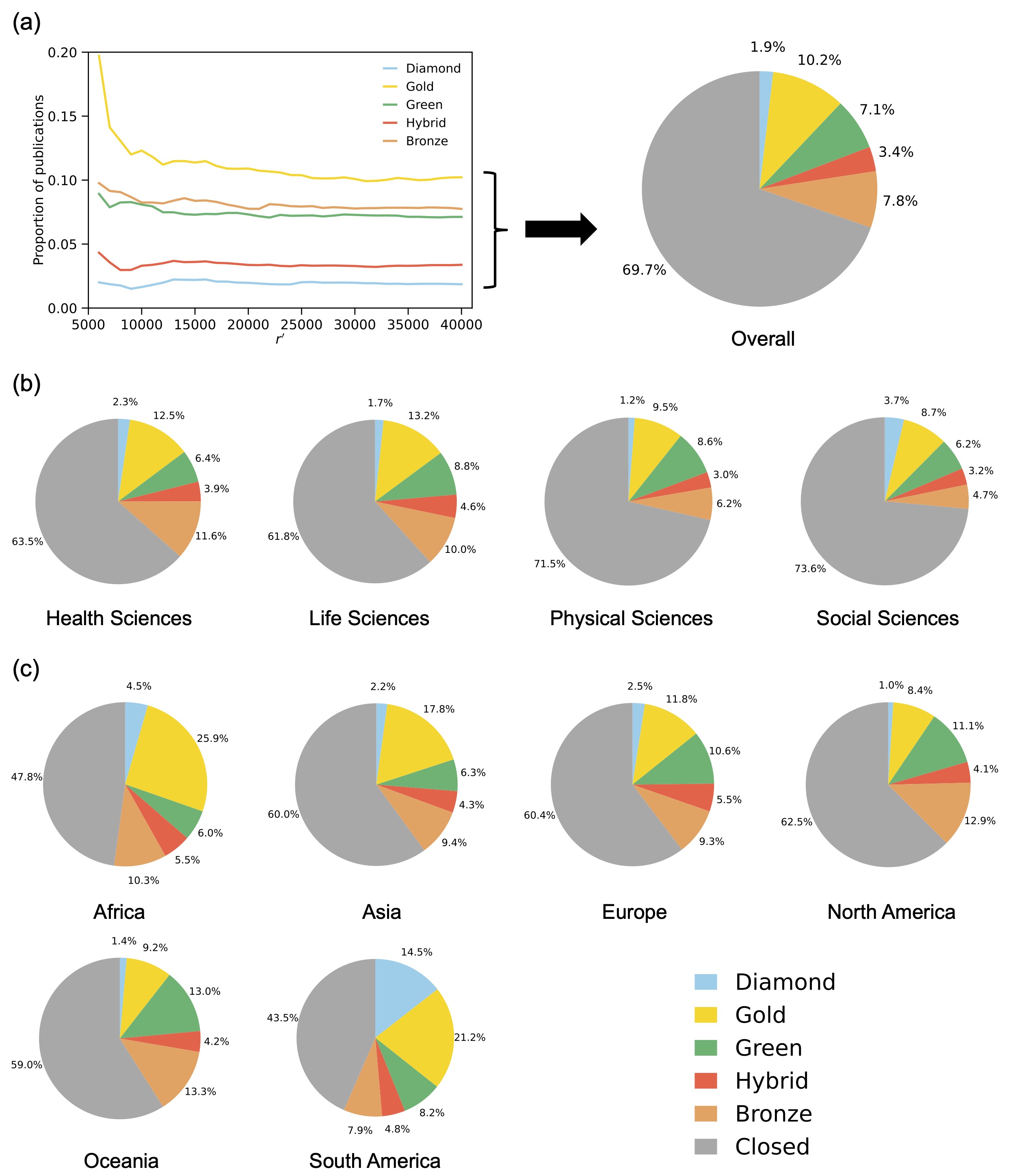
Estimating the proportion of publications in OpenAlex by open access type using random walks on a hypergraph (Applied Network Science 2025).
Selected publications
- Sampling nodes and hyperedges via random walks on large hypergraphs.
Kazuki Nakajima, Masanao Kodakari, and Masaki Aida. Applied Network Science. (2025). - Social Graph Restoration via Random Walk Sampling.
Kazuki Nakajima and Kazuyuki Shudo. Proc. ICDE. (2022). - Random walk sampling in social networks involving private nodes.
Kazuki Nakajima and Kazuyuki Shudo. ACM Transactions on Knowledge Discovery from Data. (2023). - Estimating the Bot Population on Twitter via Random Walk Based Sampling.
Mei Fukuda, Kazuki Nakajima, and Kazuyuki Shudo. IEEE Access. (2022). - Measurement Error of Network Clustering Coefficients Under Randomly Missing Nodes.
Kazuki Nakajima and Kazuyuki Shudo. Scientific Reports. (2021). - Estimating Properties of Social Networks via Random Walk considering Private Nodes.
Kazuki Nakajima and Kazuyuki Shudo. Proc. KDD. (2020).
2. Statistical Reference Models and Stochastic Block Models for Higher-Order Networks
Real-world complex systems often involve interactions among more than two individuals, such as group conversations and collaborations among multiple researchers. Such systems can be represented as higher-order networks (hypergraphs), in which a hyperedge connects an arbitrary number of nodes. Since 2020, I have worked on statistical reference models for analyzing the structure and dynamics of higher-order networks and on stochastic block models for inferring their latent group structure.
A statistical reference model generates networks that preserve particular structural properties while randomizing the others, and serves as a baseline for analyzing real-world networks. I developed the hyper dK-series, a family of reference models that progressively preserve node degree, degree correlation, redundancy coefficient, and hyperedge size depending on the model parameters. Analyzing face-to-face contact data in schools and other settings, I showed that hyperedge size affects contagion and cooperation dynamics more strongly than any node-level statistic (IEEE TNSE 2022). I also applied this approach to collaborative research grant data in the United States and analyzed how dense collaboration among institutions with many joint projects relates to research impact (Scientometrics 2023).
A stochastic block model is a probabilistic generative model for inferring latent group structure from interactions among nodes. For higher-order networks, balancing expressiveness and computational efficiency is a key challenge. In addition to a method that infers and visualizes overlapping community structure using node attributes (SNAM 2025), I proposed a multi-order stochastic block model that balances expressiveness and computational efficiency by allowing the rules generating group structure to differ according to the number of interacting nodes. It improves predictive performance over a single generative rule in many real-world datasets (arXiv 2025). I lead this line of research as the PI of a JST ACT-X project.

Comparing evolutionary dynamics of cooperation between empirical data and reference models generated by the hyper dK-series (IEEE TNSE 2022).

Projecting individuals in a workplace face-to-face contact hypergraph into a two-dimensional space based on the community structure inferred by a stochastic block model. Colors indicate departments (SNAM 2025).
Selected publications
- Learning Multi-Order Block Structure in Higher-Order Networks.
Kazuki Nakajima, Yuya Sasaki, Takeaki Uno, and Masaki Aida. arXiv. (2025). - Inference and Visualization of Community Structure in Attributed Hypergraphs Using Mixed-Membership Stochastic Block Models.
Kazuki Nakajima and Takeaki Uno. Social Network Analysis and Mining. (2025). - Higher-order rich-club phenomenon in collaborative research grant networks.
Kazuki Nakajima, Kazuyuki Shudo, and Naoki Masuda. Scientometrics. (2023). - Randomizing hypergraphs preserving degree correlation and local clustering.
Kazuki Nakajima, Kazuyuki Shudo, and Naoki Masuda. IEEE Transactions on Network Science and Engineering. (2022).
3. Metascience Based on Large-Scale Bibliographic Data
With the growing availability of large-scale bibliographic data, research that analyzes the structure and dynamics of science from a complex systems perspective, using researchers' activities and citation relationships between papers, has spread internationally. I am particularly interested in how researchers conduct research, how research outcomes are referenced and evaluated, and how bodies of knowledge develop.
Using about 100 million papers published from 1950 to 2020, I revealed gender imbalances in the number of researchers, research careers, and citation practices in China, Japan, and South Korea, and showed that the disparities are particularly large in Japan (J. Informetrics 2023). In an international collaboration with the Netherlands under a JST ASPIRE project, I developed statistical reference models that preserve the structure of citation networks and showed that papers with women as first or last authors are under-cited in computer science, particularly at top-tier conferences (AIES 2024; Scientometrics 2026).
I also proposed a framework of "researcher population pyramids," which estimates the number of active researchers in each year by gender and productivity based on the survival function of publication intervals. Constructing researcher population pyramids for 58 countries from about 150 million papers, I revealed distinct trajectories across countries: Arab countries with a large inflow of early-career researchers but a widening gender gap in productivity, the United States with a modest inflow but a narrowing gender gap, and Japan with stagnation in both (PNAS Nexus 2026). The pyramids for each country can be explored in a web app. More recently, I have extended my research to the structure of bodies of knowledge and showed that the modularity of intellectual bases, inferred from document co-citation networks, can decline as research areas emerge or shift (arXiv 2026).

Gender imbalance in Chinese, Japanese, and Korean academia: (a) fraction of female researchers, (b) total productivity, (c) annual productivity, and (d) over- and under-citation of female-led and male-led papers (J. Informetrics 2023).
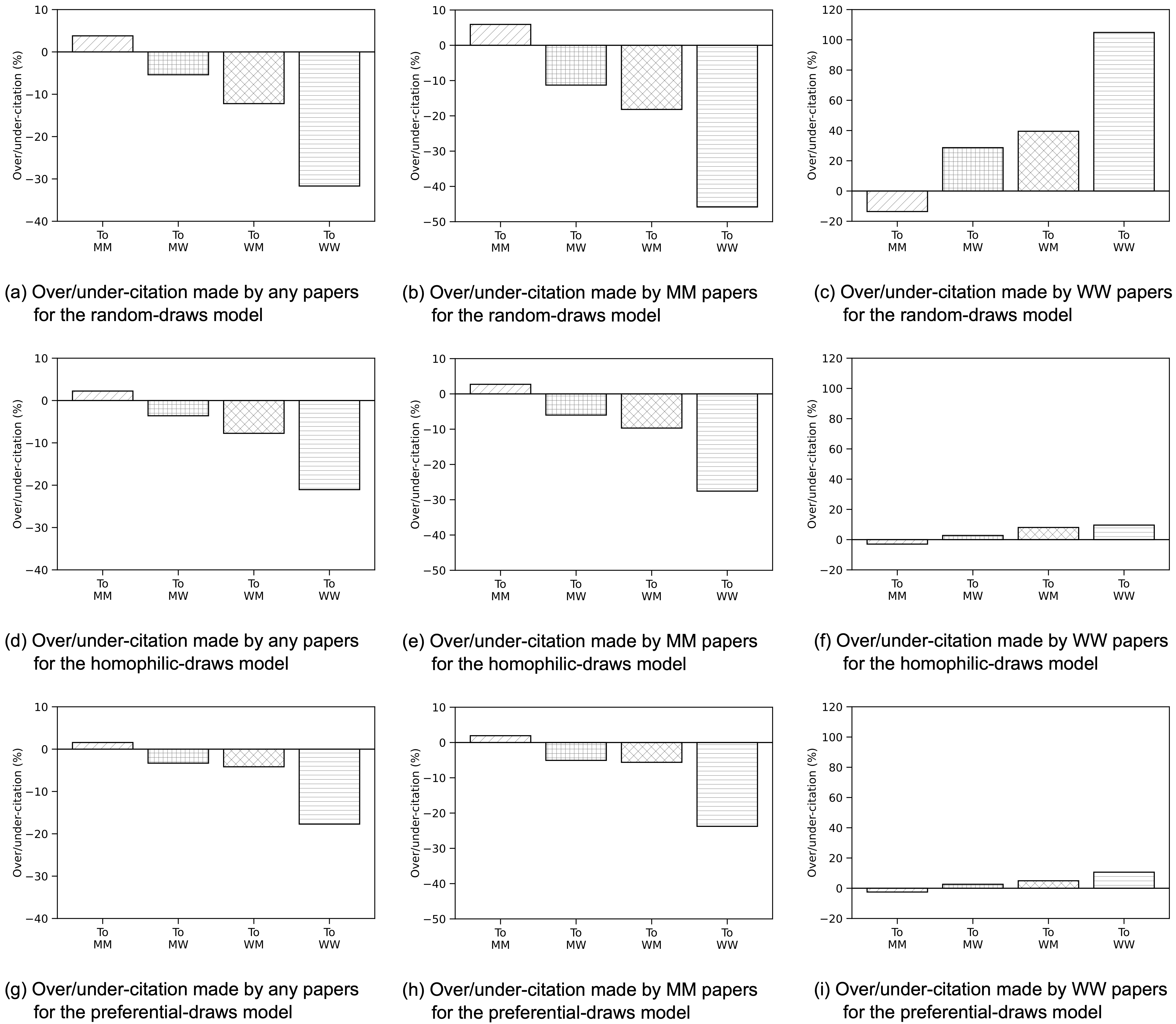
Quantifying over- and under-citation of papers by the gender combination of first and last authors (M: man, W: woman) based on three reference models (AIES 2024).
Selected publications
- Declining Modularity of Intellectual Bases During the Emergence of Research Areas.
Kazuki Nakajima, Yuya Sasaki, and Masaki Aida. arXiv. (2026). - Researcher Population Pyramids: Tracking Demographic and Gender Trajectories Across Countries.
Kazuki Nakajima and Takayuki Mizuno. PNAS Nexus. (2026). - Systemic Gendered Citation Imbalance in Computer Science: Evidence from Conferences and Journals.
Kazuki Nakajima, Yuya Sasaki, Sohei Tokuno, and George Fletcher. Scientometrics. (2026). - Quantifying gendered citation imbalance in computer science conferences.
Kazuki Nakajima, Yuya Sasaki, Sohei Tokuno, and George Fletcher. Proc. AIES. (2024). - Quantifying gender imbalance in East Asian academia: Research career and citation practice.
Kazuki Nakajima, Ruodan Liu, Kazuyuki Shudo, and Naoki Masuda. Journal of Informetrics. (2023). Covered by the Asahi Shimbun and ITmedia News.